Charter of the BRICS-ASEAN Independent Commission for Trade & Economy
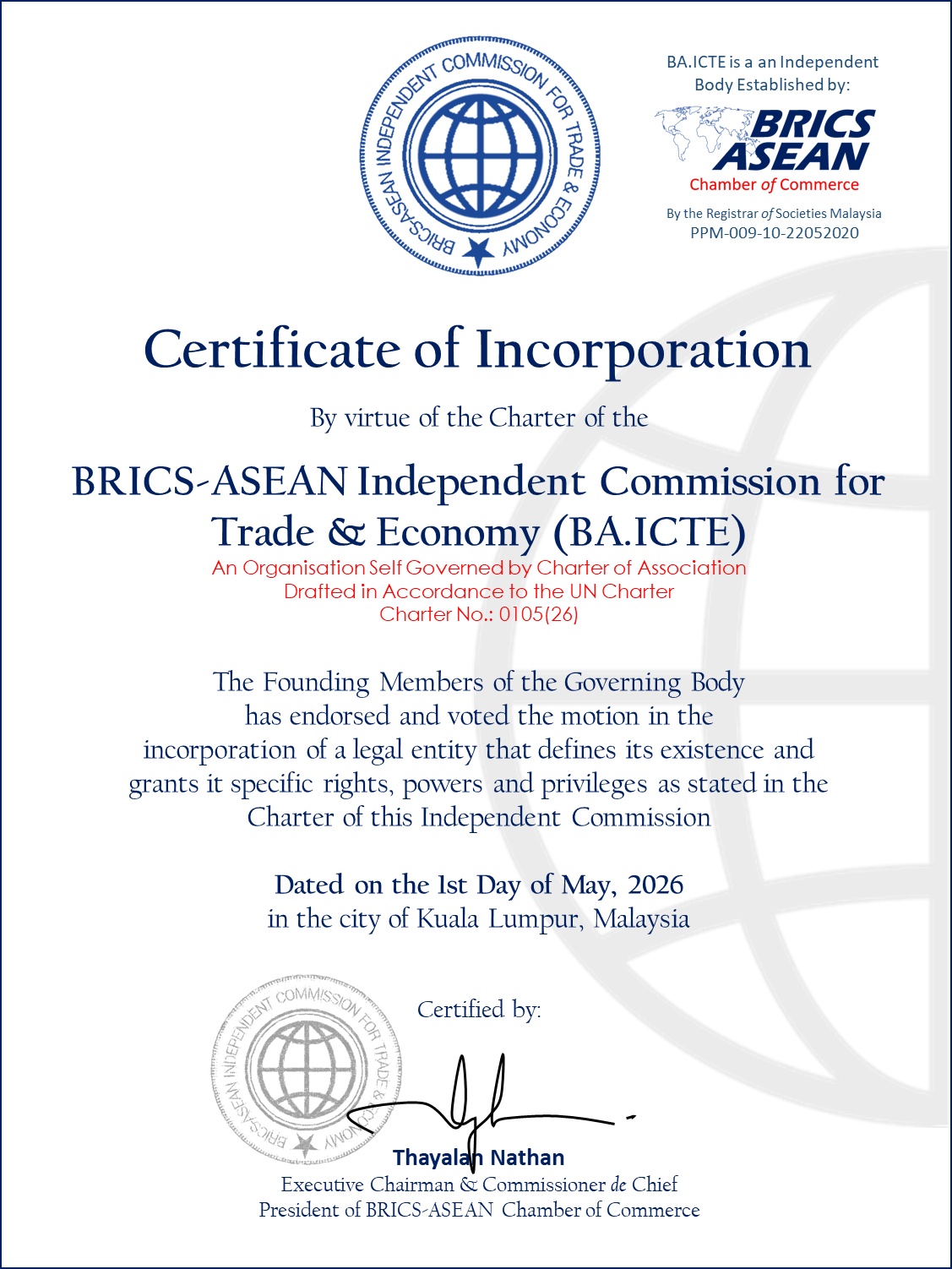
BA.ICTE is an independent body established under the Registrar of Societies Malaysia PPM-009-10-22052020, tabled by the President of the BRICS-ASEAN Chamber of Commerce with 11 founding members of the Governing Council.
The Commission
A · 1 Establishment
The BRICS-ASEAN Independent Commission for Trade & Economy (BA.ICTE) is hereby established as an independent body, tabled and proposed by Thayalan Nathan, the President of the BRICS-ASEAN Chamber of Commerce (BACC), with 11 founding members of the Governing Council. The Commission is deemed to be a not-for-profit body and non-governmental organisation. It aims to be an independent, self-governed body under its own charter — multilateral, non-political — a trade facilitation and economic coordinating body representing independent members from BRICS, ASEAN, Partner Nations and institutional members.
As an independent organisation, BA.ICTE therefore undertakes the task to appoint highly suitable candidates to become Trade Commissioners from across global regions, multiple professions and industries.
Its Founding & Incorporation Charter No. 0105(26), adopted at the 1st Annual General Assembly, was primarily established to institute an independent Council of Trade Commissioners. The Charter spells out that:
As an outcome, this Charter has been established with the following guiding principles and virtues to be incorporated as the Founding Charter of BA.ICTE.
A · 2 Vision
A · 3 Mission
- To facilitate bilateral and multilateral trade & business opportunities
- To promote cross-border investments and strategic partnerships
- To enhance economic diplomacy through accredited trade commissioners
- To support inclusive, digital, and sustainable economic development
- To propagate wealth creation, wealth sustainability and wealth sharing
- To play the role of diplomatic “Peace Makers” for global trade, economy, geo-politics and social service
A · 4 Objectives
The Commission shall:
- Promote trade liberalization and market access among member countries
- Facilitate investment pipelines across priority or growth sectors
- Serve as a structured platform for trade commissioners’ collaboration
- Provide advisory and policy recommendations to governments and institutions
- Support SMEs and emerging industries in international expansion
- Develop digital trade ecosystems and fintech-enabled trade solutions
- Strengthen supply chain resilience across BRICS-ASEAN corridors
- Facilitate sustainability and fairness on Global Energy and Food Security
- Establish wealth generating projects to embark into economic recovery
- Play the role as the independent and private global policy makers
A · 5 Membership
5.1 Categories
- Full Members — paid members
- Associate Members — appointed members, representing Regions or Industry Experts
5.2 Eligibility
Members must demonstrate:
- Proven involvement in international trade or investment facilitation
- Alignment with the Commission’s objectives
- Good moral, ethical and professional standing
5.3 Appointment & Removal of Independent Trade Commissioners
- Any two (2) Executive Council Governing Members can propose and second the appointment of a Trade Commissioner
- The appointment is for every three (3) years, renewable
- The removal of a Trade Commissioner follows investigations into complaints, wrongdoings in the eyes of the law, misconduct, or by the discretion of the Executive Council of Governing Members
A · 6 Governance Structure
6.1 The Executive Council of the Governing Members
- Responsible for strategic direction and policy execution
- Includes:
- The Executive Chairman, who is also the Commissioner de Chief of the Executive Council of the Governing Members and the Principal Founder
- The Secretary General of the Assembly
- The Board of Advisors
- Members of the Executive Council of Governing Members
- The supreme decision-making body, comprised of selected Senior Trade Commissioners who form the Executive Council of Governing Members
- The Governing Members are chaired by the Executive Chairman and/or the Secretary General of the Assembly
- Bi-monthly Executive Governing Members discussions are held on a digital platform
- Holds the Annual General Assembly of the BRICS-ASEAN Independent Commission for Trade & Economy — an exclusive, by-invitation meeting
6.2 Secretariat / ICTE Centre
The ICTE Centre shall serve as the Secretariat and administrative arm, responsible for operations, coordination and communications.
6.3 Advisory Board
- Trade Commissioners cum Advisory Board Members
- Experts in economy, trade, finance, law, industry and geopolitics
- Provides strategic insights and independent guidance
A · 7 Roles and Responsibilities
7.1 Executive Council — Institutional Role
The Executive Council shall:
- Act and serve as a link or catalyst between BRICS, ASEAN and global economies
- Develop frameworks for trade facilitation and dispute resolution
- Organize international business, investment and trade missions and the Annual Assembly
- Establish sector-specific industry working groups (e.g. energy, digital economy, education, agriculture)
- Maintain a centralized trade intelligence and data-sharing platform
7.2 Independent Trade Commissioners
Trade Commissioners are the core operational agents of the Council. The Charter warrants that:
Key Roles
- Represent trade interests of assigned jurisdictions or sectors
- Facilitate business matchmaking and partnerships
- Identify and develop investment opportunities
- Support exporters and investors entering new markets
- Promote bilateral and multilateral trade agreements
- Serve as Independent Diplomatic Ambassadors
Key Responsibilities
- Market Intelligence — provide timely insights on market trends, regulations and risks
- Trade Facilitation — assist individuals, companies or governments in navigating trade and business opportunities; reduce barriers to entry
- Investment Promotion — identify bankable projects and connect investors; support due diligence processes
- Independent Diplomatic Engagement — liaise with government agencies and trade bodies; represent the Council in official and semi-official capacities
- Compliance & Ethics — adhere to international trade laws and anti-corruption standards; maintain transparency in all dealings
- Reporting — submit periodic reports on trade activities, outcomes and pipeline developments
7.3 Executive Leadership
- Executive Chairman and/or Commissioner de Chief — provides overall leadership and strategic direction; manages Secretariat operations; represents the Council globally
- Chairman, Board of Advisors — oversees implementation of policies
- Governing Council Members — oversee implementation of policies
A · 8 Key Functions
- Trade Missions & Delegations — organize inbound and outbound trade missions
- Annual Assembly — host the annual assembly of BRICS-ASEAN Independent Commissioners for Trade & Economy
- Digital Trade Platform — develop a secure platform for trade matching and transaction facilitation
- Capacity Building — provide up-skilling, training and certification for Trade Commissioners and all stakeholders
- Policy Advocacy — publish white papers and recommendations; quarterly journal
A · 9 Funding Mechanisms
- Membership fees
- Grants and development funding
- Sponsorships and partnerships
- Annual Awards
- Revenue from events, certifications, and advisory services
A · 10 Code of Conduct
All members shall:
- Uphold integrity, professionalism, and neutrality
- Avoid conflicts of interest
- Comply with international trade and anti-corruption laws
- Promote fair and inclusive trade practices
A · 11 Dispute Resolution
- Internal mediation mechanisms
- Arbitration panels where necessary
- Alignment with internationally recognized arbitration frameworks
A · 12 Amendments
This Charter may be amended by a two-thirds majority vote of the Executive Council of Governing Members.
A · 13 Dissolution
The Council may be dissolved by a three-fourths majority vote, with applicable legal frameworks by BA.ICTE.
A · 14 Adoption of Working Relations
BA.ICTE plans to cooperate and affiliate with international organisations such as UNCITRAL, the OECD, the ASEAN and BRICS secretariats, as well as the Trade Ministries of respective nations.
A · 15 Additional Privileges of Trade Commissioners
- A Letter of Appointment and a Certificate of Appointment shall be provided with a unique Membership ID
- All Trade Commissioners are allowed to publish their appointed position as “Trade Commissioner for … (Designated Portfolio Given) representing BRICS-ASEAN Independent Commission for Trade & Economy” in any promotional P.O.S. materials, including announcing it to the media
- All appointed Trade Commissioners are privileged to use the term “Honorary” (Hon.) before their names
- Trade Commissioners will be given the first right of refusal should BACC or BA.ICTE embark on any global-scale business, project or venture
- A Trade Commissioner’s Seal — warrants ethical, credible and honest conduct in the highest order
- All Trade Commissioners shall have their own Seal authorized only by BA.ICTE, to undertake the powers of interest vested upon them to individually represent their capacity as a Trade Commissioner. Examples of the stamp / seal:
Charter of the Trade Commissioner
B · 1 Preamble
This Charter establishes the mandate, authority, responsibilities, and operational framework of the Independent Trade Commissioner. The role is instituted as a diplomatic representative to advance international trade, foster economic cooperation and promote sustainable investment between jurisdictions.
The Trade Commissioner acts as an official representative to facilitate cross-border commerce, strengthen bilateral and multilateral trade relations, and support businesses in accessing global markets.
B · 2 Purpose and Objectives
2.1 Purpose
To serve as a strategic conduit between governments, industries and international markets in order to:
- Promote trade and investment flows
- Enhance economic diplomacy
- Support business expansion and market access
2.2 Core Objectives
- Increase bilateral and multilateral trade volumes
- Facilitate foreign direct investment (FDI)
- Strengthen SME internationalization
- Promote national and regional exports
- Support economic policy alignment and cooperation
B · 3 Scope of Authority
The Trade Commissioner shall operate within the mandate granted by the appointing authority (BA.ICTE), with authority to:
- Represent trade interests in designated jurisdictions
- Engage diplomatically with public and private sector stakeholders
- Facilitate trade negotiations (non-binding unless authorized)
- Provide advisory and strategic trade insights
- Initiate trade missions, forums, and investment roadshows
B · 4 Roles and Responsibilities
4.1 Trade Promotion
- Identify and develop business opportunities
- Promote domestic industries internationally
- Organize or promote trade exhibitions, missions, and networking events
4.2 Investment Facilitation
- Attract foreign investors
- Provide market entry advisory services
- Facilitate partnerships, joint ventures, and strategic alliances
4.3 Market Intelligence & Advisory
- Conduct market research and economic analysis
- Provide insights on trade regulations, tariffs, and compliance
- Advise stakeholders on risks and opportunities
4.4 Stakeholder Engagement
- Build relationships with government agencies, chambers, and corporations
- Act as liaison between businesses and regulatory bodies
- Support dispute resolution and trade facilitation
4.5 Policy Support
- Contribute to trade policy recommendations
- Provide feedback on international trade agreements
- Support economic diplomacy initiatives
B · 5 Appointment and Tenure
- Trade Commissioners shall be appointed by the governing authority, i.e. the BA.ICTE Governing Council
- Appointment is honorary and/or executive in nature
- Term duration: typically 2 years, renewable based on performance
- Subject to code of conduct and performance review
B · 6 Code of Conduct and Ethics
Trade Commissioners must:
- Act with integrity, transparency and professionalism
- Avoid conflicts of interest
- Maintain confidentiality of sensitive information
- Uphold the reputation of the appointing body
- Comply with international trade laws and local regulations
B · 7 Governance and Reporting
- Report to the appointing authority or governing council
- Submit periodic performance and activity reports
- Participate in strategic planning and review sessions
- Be subject to audit and compliance checks
B · 8 Performance Metrics (KPIs)
Evaluation shall be based on:
- Trade deals facilitated
- Investment value generated
- Number of business engagements and partnerships
- Market access achievements
- Contribution to economic development initiatives
B · 9 Operational Framework
9.1 Regional Representation
Each Trade Commissioner may be assigned a specific:
- Country or region
- Industry sector (e.g. manufacturing, digital economy, agriculture)
9.2 Collaboration
- Work with embassies, trade offices, and international organizations
- Partner with chambers of commerce and trade associations
- Engage government agencies and government-linked companies
B · 10 Privileges and Limitations
Privileges
- Official recognition as Trade Commissioner
- Access to trade networks and forums
- Authority to represent in designated engagements
Limitations
- No authority to sign binding agreements unless expressly authorized
- Must not engage in unauthorized commercial activities under the title
B · 11 Termination and Revocation
Appointment may be revoked in cases of:
- Misconduct or breach of ethics
- Non-performance
- Conflict of interest
- Actions detrimental to the appointing body
B · 12 Amendments
This Charter may be amended by the governing authority to reflect evolving trade dynamics, regulatory changes, and strategic priorities.
B · 13 Adoption
This Charter has come into effect by the approval of the governing body and shall serve as the guiding framework for all appointed Trade Commissioners. The Charter for the engagement of Trade Commissioners is aligned with WTO, ASEAN and BRICS frameworks.
Adopted and signed on this day, 1st of May 2026, for and on behalf of the Governing Council of the BRICS-ASEAN Independent Commission for Trade & Economy:
Executive Chairman & Commissioner de Chief (BA.ICTE)
President of BRICS-ASEAN Chamber of Commerce
Tel: +6 017 880 9454 · Email: president@bricsasean.org